




News
Upcoming conference 2009: Education, Education, Education
Click here to download and view the Deaf Parenting Annual Conference 2009 flyer (PDF format)
Sabina Iqbal, Chair/Founder of Deaf Parenting UK as first Deaf as one of the most powerful Muslim Women in Britain
"More Muslim women than ever are in leading positions in society, a fact that is at worst misrepresented and at best under-reported. Britain’s first Muslim Women Power List aims to change all that and recognise the women who are making a difference."
The article can be found in 'The Times Magazine' inside The Times Newspaper out today (Saturday 21st March 2009)
If you missed it - check out on this link:
http://women.timesonline.co.uk/tol/life_and_style/women/article5918094.ece
BABY SHOW , BIRMINGHAM, NEC

NewGen Magazine and Article
Click here to download the DPUK Conference Press Release Deaf Parenting UK are proud to have been featured with a Deaf Mum (Chair/Founder of Deaf Parenting UK) as the front cover, portray a positive image of Deaf parent, with two double spread about her experience as Deaf mum and the work of Deaf Parenting UK. The NewGen Magazine is run by National Childbirth Trust.
The article is out now on March 2009 edition of NewGen as attached. Please do let us know your views/ comments about the article.
You can also download and view the article by clicking here
To learn more about Deaf Parenting UK and the work we do, check out our website www.deafparent.org.uk
Deaf Parenting Conference Press Release
Click here to download the DPUK Conference Press Release
Deaf Parenting UK Conference flyer
Click here to download the DPUK Conference Flyer
Deaf Parenting UK is delighted to work in partnership with Sign-tube to bring you information about Deaf Parenting Conference 2009 in British Sign Language
See us at The Baby Show with Prima Baby sponsored by Volvo, ExCeL, London - 27 February - 1 March 2009
The Baby Show with Prima Baby sponsored by Volvo enables parents to give their baby the best start; with unbeatable shopping with many products cheaper than internet prices, fantastic entertainment and access to great information and advice – the Show really is an essential part of having a baby.
There are lots of experts and activities including: child nutritionist Annabel Karmel, Tommy’s midwives and health visitors, sleep expert Jo Tantum, essential baby and toddler first aid skills from St John Ambulance, fashion shows, play zones and much more!
What’s more, The Baby Show really is a hassle free day out with free nappies and wipes, crèche, feeding area as well as Shopping Drop-off, Collect by Car and Home Delivery.
What’s more we will be at the Show providing BSL interpreters each day from our stand. This will enable you to meet the many experts at the various stands and is a fantastic opportunity for Deaf parents to ask questions and learn about baby stuff during the three day show.
The Baby Show is a great day out for the whole family – mums, dads, grandparents, friends, babies and toddlers!
Ticket prices:
- Standard advance – from £11.95
- Standard on the door – from £13.50
- Grandparent advanced ticket – from £11.00
- Tommee Tippee promotion + entry ticket – from £15.90
- Kids 0 -10 GO FREE
Opening hours :
- 9.30 - 5.30 daily
Book Tickets
To further information and to book tickets please click here or call 0871 231 0844*, quoting EX146
We look forward to seeing you there!
*Calls charged at national rate. Booking fee applies. The advance box office closes on 26 February 2009.


DPUK Christmas and New Year
Deaf Parenting UK will closed from 12 noon on Wednesday 24th December 2008 and re-open on Wednesday 7th January 2009. On behalf of DPUK Team, we wish you all a joyful and peaceful Christmas and Best wishes for a Happy New Year!
DPUK Press Release 8 December 2008 - Beacon Prize 2008 Highly Commended
DPUK Press Release 8 December 2008 - Beacon Prize 2008 Highly Commended (word)
Channel Five News as a major breakthrough, to have their first signed story! broadcasted on 18th November 2008
We are so proud to influence Channel Five News by featuring a Deaf person using BSL - Sabina Iqbal, Chair/Founder of Deaf Parenting UK was on Channel 5 News at 5pm for a minute, on Tuesday 18 November (Yours News, Your story) about Deaf Parenting UK. This is seen by Channel Five News as a major breakthrough, to have their first signed story on their programme!
Just in case if you missed it, you can view it online on this link: www.fivetvonline.tv/news.php?news=1297. Feel free to circulate to your colleague, family, and friends.
Please let us know your thoughts after you seen the programme as we want to raise awareness about the needs of Deaf Parents and raise profile of Deaf Parenting UK.
To learn more about Deaf Parenting UK and to qualify for free membership for Deaf parents/ families, please visit our website on www.deafparent.org.uk.
DPUK Conference 2008
Deaf Parenting UK Conference 2008 videos and transcripts added.
Please click here to visit the DPUK Conference 2008 page
DPUK Press Release 25 November 2008 - The Guardian Public Services Award 2008
Deaf Parenting UK has been honoured as Runner Up for The Guardian Public Services Award 2008, at a lavish ceremony in London on 25th November 2008 at the Old Billingsgate, London.
DPUK Press Release 25 November 2008 - The Guardian Public Services Award 2008 (Word)
DPUK Press Release 7 November 2008 - Women in the Future Award 2008
Britain`s most inspirational Sabina Iqbal has been honoured in the BT Women in the Future Voluntary Award, presented by Princess Zahra Aga Khan. Judges of this category included Clive Alderton, deputy private secretary to TRH The Prince of Wales and The Duchess of Cornwall at a lavish ceremony in London on 6th November 2008 at the London Marriott Grosvenor Square.
The mission of the Women of the Future Awards is to showcase young talent of women breaking through the glass ceiling including the generosity of women, who not only building phenomenal business and careers but who want to give something back. It is humbling to see so many busy and successful young women devoting their precious time to sharing their experiences with the next generation. The evening was celebrated with the awards host - Kate Derham, ITV Newscaster; with well-known VIPs and celebrities in attendance, including Naga Munchetty of BBC Working Lunch, Theresa May, MP & Shadow Leader of the House of Commons and Shadow Minister for Women and Baroness Sue Greenfield (scientist). Many women are inspired by her achievements.
The judges said: "Sabina is someone who spotted a gap in service provision and had the motivation to plug it - overcoming numerous barriers to do so. She has transformed the provision of services to this group in the UK and we have every confidence that she will go on to do the same overseas. She has created a truly sustainable, world-class organisation in the voluntary field."
Deaf Parenting UK Spokesperson: “Sabina, even as Deaf Asian woman, is an excellent role model and an inspiration to many women across the UK and the world. Her achievements are amazing, especially in her voluntary capacity, where she founded Deaf Parenting UK and her vision for the future for Deaf parents, enabling them to have a voice in the society and sharing models of good practices. For many, she is our Queen of Heart, so passionately campaigning and supporting the equality of Deaf parents".
DPUK Press Release 7 November 2008 - Women in the Future Award 2008 (Word)
DPUK Press Release 6 November 2008 - Talk Talk Award Innovation in the Community Award 2008
Deaf Parenting UK win TalkTalk's Innovation In The Community Award 2008 enable charity and community group throughout the UK to harness the power of the Internet. Deaf Parenting UK was chosen as one of the 30 winners to receive the award in an award ceremony at the House of Lords on 5th November 2008.
We were also delighted to have been a Runner Up for The Dacorum Excellence Award 2008 to recognise Deaf Parenting UK success and achievement by the local community.
DPUK Press Release 6 November 2008 - Talk Talk Award Innovation in the Community Award 2008 (Word)
DPUK Press Release 31st October 2008 - Shortlisted for Women of the Future Award 2008a
Sabina Iqbal, Chair/Founder of Deaf Parenting UK, has been shortlisted for an award at the national Women of the Future awards. The awards celebrate high-achieving women under 35.
Sabina is in the running for the Women in the Future Award at the ceremony in London on 6 November.
A Deaf Parenting UK spokesman said: “Sabina is extremely dedicated, working tirelessy on voluntary basis, campaigning for the equality of Deaf parents in accessing to services. Everyone are rooting for her.”
DPUK Press Release 31st October 2008 - Shortlisted for Women of the Future Award 2008a (Word)
DPUK Press Release 21 October 2008 - The Baby Show Earl Court
Deaf Parenting UK had their exhibition stand at the Baby Show, Earl Court, 17-19 October 2008 and provided BSL interpreters to enable Deaf parents to enjoy the experiences of The Baby Show in the same way as many other parents. Exhibitors were able to take advantage of the unique service to communicate with Deaf parents as new customers.
DPUK Press Release 21 October 2008 - The Baby Show Earl Court (Word)
DPUK Press Release 20 October 2008- New Ambassador Maria Miller MP Shadow Minister for the Family
Deaf Parenting UK is pleased to announce to welcome our new ambassador Maria Miller MP to join our Board of Ambassadors to promote awareness on the needs of Deaf parents.
DPUK Press Release 8 October 2008- Deaf Parenting UK made a breakthrough...
Department of Health, Department of Children, School and Families, Equality and Human Right Commission have made their pledges to address the needs of Deaf Parents.
The pledges were made at the Deaf Parenting Conference 2008 in Birmingham on Saturday 4th October 2008 where many Deaf Parents, professionals/ services providers working with Deaf parents challenged the Government on the needs of Deaf parents in accessing to services without barriers. The event was filmed by BBC See Hear.
Please see press release below for more information.
DPUK Press Release 7 October 2008- DPUK win Social Impact Award
Deaf Parenting UK, www.deafparent.org.uk the first ever charity to be run by Deaf parents for Deaf parents, has won TFPL’s first Social Impact Award - an award for the most innovative use of knowledge and information management in the voluntary sector.
The award, which was introduced by TFPL at their EBIC conference in Berlin October 1-3rd, was open to organisations in the charity and voluntary sectors who could demonstrate innovative use of knowledge and information management (KIM) which includes information, knowledge, records or technology management.
DPUK Press Release 7 October 2008- DPUK win Social Impact Award 2008 (Word)
DPUK Press Release 22nd September 2008
We are delighted to welcome two key leaders, Markku Jokinen, who is President of World Federation of the Deaf (WFD), one of the world leaders in the Deaf World as Ambassador for Deaf Parenting UK. and one is Boris Johnson, who is Mayor of London – one of the major cities in the world, who gave his support to Deaf Parenting UK and our work.
DPUK Press Release 22nd September 2008 (Word)
DPUK Annual Report 2007
Click here to download DPUK Annual Report 2007 (PDF)
DPUK Press Release 27th August 2008- DPUK Conference 4 October 2008
Deaf Parenting UK is pleased to announce their excellent range of speakers for our upcoming conference in Birmingham.
Speakers also include Shadow Minister, Government, Department of Health, DSCF, Equality & Human Right Commission, Nursing and Midwifery Council, NSPCC, Professor of International Sign Language and Deaf Studies as well as Lord Mayor and Cabinet Member of Birmingham City Council, and on local level as Early Year Senior Educator who researched on Every Parents Matters.
Please see attached press release with quotes from our speakers.
"Limited places, please book early to avoid disappointment"
Crèche available, please book your child(s) places in advance to confirm numbers.
To learn more, our programme, speakers and their profile and our Chair’s welcome are available as attached.
To book your place, please email us on info@deafparent.org.uk
Click below to download the press release and find out more:
DPUK Press Release 27th Aug - DPUK Conference 4 Oct 2008 (Word)
DPUK Press Release 19th August 2008- BBC See Hear
Deaf Parenting UK and BBC See Hear are working together to make a programme on Deaf Parents and their experiences to highlight the issues they faces in accessing to services.
Please see press release below. Please submit your experience urgently to angela.spielsinger@bbc.co.uk or info@deafparent.org.uk.
DPUK Press Release 19th Aug (Word)
DPUK Press Release 18th August 2008 -Emmerdale
EMMERDALE ARE THRILLED TO LED SUPPORT TO DEAF PARENTING UK
Emmerdale, a popular ITV British Soap have joined Deaf Parenting UK’s list of celebrities to led their support of our work.
Deaf Parenting UK are delighted to welcome Emmerdale. Other celebrities of supporters also include Her Majesty, The Queen, Niki Evan of X-Factor, Coronation Street and many more. Check out our website on www.deafparent.org.uk/celebrity.php
Click below to download the press release and find out more:
DPUK Press Release 18th Aug 2008 - Emmerdale (Word)
DPUK Press Release 13th August 2008 - the Baby Show
DEAF PARENTING UK LAUNCHES WORKING PARTNERSHIP WITH THE BABY SHOW ON 17 - 19 OCTOBER, EARL COURT
Deaf Parenting UK is proud to work in partnership with The Baby Show to ensure that Deaf Parents are fully inclusive.
Deaf Parenting UK will provide BSL interpreters each day of the Show from Deaf Parenting UK stand, enabling Deaf parents to meet experts at various stands. This is a fantastic opportunity for Deaf parents to ask questions and learn about baby stuff during the three days show at Earls Court.
Click on the links below to download and find out more:
DPUK Press Release 13th Aug 2008 - the Baby Show (Word)
DPUK easyfundraising
There's now two easy ways for you to help raise funds for Deaf Parenting UK!
Shop Online and Raise Funds
easyfundraising is a shopping directory listing some of your favourite online stores including Amazon, NEXT, Debenhams, John Lewis, Toys R Us, HMV and over 500 others. Just use the links on the easyfundraising site whenever you shop online and, at no extra cost to you, we'll receive a free donation of up to 15% from every purchase you make. It really is that simple!
It's completely FREE to register and you won't pay a penny more for your shopping when you use the easyfundraising site. In fact you can even SAVE MONEY as many retailers offer discounts, special offers and even 'e-vouchers' exclusive to easyfundraising.
If you shop online anyway then why not raise valuable extra funds for us by using this fantastic scheme. All you need to do is visit www.easyfundraising.org.uk/dpu and when you register, select Deaf Parenting UK as the organisation you wish to support.
Search the Web and Raise Funds
You can also raise funds when you search the Web - with easysearch, a search engine with a difference!
When you search the Web with easysearch, you'll raise funds for us with every search you make! Just like easyfundraising it's completely free to use and if you make just 10 searches a day, you could raise £20-£25 a year - or more - for us, just by switching to easysearch.
What's more, easysearch is a 'super' search engine that combines the strengths of several search providers together - Yahoo!, MSN Live Search, Ask.com and many more. easysearch tracks down the most relevant and accurate results from across the Web, which means you'll find what you're looking for quickly and easily every time - all in one 'easy' search.
Check out our unique easysearch page at http://dpu.easysearch.org.uk and use it every time you search the Web.
Click any of the resources links below to download:
Easyfundraising DPUK flyer (Word)
Deaf Parenting UK Conference 2008: Empowering, Enabling and Supporting Deaf parents
Deaf Parenting UK are delighted to host their Annual Deaf Parenting Conference 2008 on Saturday 4th October 2008 at Deaf Cultural Centre, Birmingham.
Sabina Iqbal, Chair/Founder of Deaf Parenting UK explained: "As 90% of Deaf children comes from hearing families and when they grow up into adults and become parents and yet very little resources and support is available to them in an accessible format. This is particularly noticeable as Deaf Adults have a 90% chance of having hearing children where access is a real issue."
The following is common in Deaf parents' daily lives, as services offered to Deaf parents are sometimes non-existent, very limited or patchy as compared to those available to hearing parents:
Deaf parents are unable to access mainstream information, including maternity, parenting skills classes, midwives or health visitors. Deaf parents find it difficult to access to childcare, nursery or participate in primary and secondary school life adequately due to staff inability to communicate in sign language or because of lack of Deaf awareness. This has in turn prevented Deaf parents of their human right to participate fully in their family lives.
Sabina added: "The conference will have decision-makers from Government and that is a fantastic opportunity for all of us as Deaf parents and professionals to put forward questions, influence and raise issues on the needs of Deaf parents and what can Government do to ensure that Deaf parents/families have equal access to all services without barriers."
The conference provides an exciting programme of speakers and workshops as well as crèche with fun activities for children of Deaf parents. This is also an excellent opportunity for you all to meet with other Deaf parents, families and professionals, to work together of how we can move forward toward empowering, enabling and supporting Deaf parents.
"Limited places, please book early to avoid disappointment"
If you want to know more about the conference or to book your place, please contact us at Deaf Parenting UK on info@deafparent.org.uk
Deaf Parenting Annual Conference 2008 flyer (PDF file)
DPUK Press Release 30 June 2008
Deaf Parenting UK are delighted to welcome Rosie Cooper MP to our board of Ambassadors.
In addition to her MP background, Rosie is also well-known as CODA (child of Deaf adult) and delighted to share her experiences of growing up with her deaf parents and the struggles her deaf parents faces. For this reason, she is supporting Deaf Parenting UK work in campaigning for Deaf parents to have equal access to services without any barriers.
We are also delighted to have support from Anne McGuire, Minister for Disabled people, who recognised the uniqueness of our work at Deaf Parenting UK.
Furthermore, we continue to receive support and recognition of our work from Makhosini P. Makhubu, Executive Director of Swaziland National Association of the Deaf in Africa and Dr Gary Morgan, co-director of DCAL - Deafness, Cognition and Language research centre in UK.
Please see the press-release for their comments on Deaf Parenting UK and our work. We continue to work with our partners organisations in enabling confidence, empowering and supporting Deaf parents in UK and strive to be a model of good practice on international level.
If you need more information, please do not hesitate to contact me by email.
DPUK Press Release 30 June 2008 (PDF file)
Deaf Parenting UK now on FACEBOOK
Deaf Parenting UK has now launched their profile onto Facebook group which is free to join and enable us to increase our membership base. If you are on Facebook, please ensure you add Deaf Parenting UK as your group and invite all your friends to join too.

Anne McGuire Minister for Disabled People
We are very delighted to welcome support from Anne McGuire, Minister for Disabled People on our work at Deaf Parenting UK. Click here to read full.
DPUK Press Release June 2008
DPUK Press Release June 2008. Please click below to view/download.
DPUK Press Release June 2008 (PDF file)
BSL Comedy Show - An Audience with john Smith
DPUK is hosting a forthcoming BSL Comedy Show - 'An Audience with John Smith'. Click link below to view poster for further details:
DPUK BSL Comedy Show Poster (PDF file)
Press Release and Ambassadors of DPUK profiles
Please click on the link below to view / download the DPUK press release and DPUK ambassadors profiles:
DPUK Ambassadors Profiles (PDF file)
The DPUK Team
DPUK Annual Report 2006
Please click on the link below to view / download the DPUK Annual Report 2006:
DPUK Annual Report 2006 (PDF file)
The DPUK Team
DPUK Parenting Skills Courses
Please click on the link below to view / download the latest DPUK Parenting Skills Courses Poster:
The DPUK Team
DPUK Christmas and New Year
Deaf Parenting UK will close from Friday 21st December 2007 and re-open on Monday 7th January 2008.
We wish you all an enjoyable festive season and have a great New Year!
From DPUK Team
RAD Deaf Cultural Mela - Saturday 20th October 2007
Royal Association for Deaf People hosted a Cultural Mela at Eastbury Comprehensive School in Barking, Essex.
The daytime event consisted of various exhibition stands, workshops, taster sessions, and interactive activities that attracted people of all ages and from a variety of Black, Minority & Ethnic (BME) background. A special guest of honour was attended by Carol Vincent from Channel 4’s ‘Big Brother.
Deaf Parenting UK set up their own exhibition stall and played a role in facilitating access to information and services.
The evening event provided a vibrant display of various dance, mime and music – performances that took place on the stage. The event was a success, which made a huge difference to the BME community. Royal Association for Deaf People will be planning a better and bigger Mela event for next year!
UK Council on Deafness 2007 Annual Conference-
Tuesday 6th November 2007
The Fourth Annual Deafness Conference was an opportunity for all professionals working with deaf people to meet and network with colleagues and to gain a greater understanding of developments taking place across the country.
Deaf Parenting UK gave a supporting presentation to over 90 different sectors that attended the event. An exhibition stall was also set up to provide information and access to DPUK Services.
A great opportunity to network and chat with people from other sectors and a chance to get DPUK on the ‘map’
Lewisham Sign Language Community–
Tuesday 13th November 2007
Lewisham Sign Language Community Group is a Deaf Forum set up for the benefit of deaf people living in the Lewisham community. The group provides a number of activities including healthy living, group meetings, social events etc
Deaf Parenting UK gave a 2hour presentation about the service provision for deaf parents to a group of 20/25 deaf people.
For more information about the group or to obtain details of future events - contact Jessica Wilde: queen79@yahoo.com
DPUK Seminar - Friday 23rd November 2007
The aim of this seminar was to show service professionals within the Health, Social Services, Mainstream parenting organisation and education on how well DPUK have achieved and highlighting the gaps in services for Deaf parents/deaf parents to be.
Around 30 service professionals from different sectors and 12 deaf parents attended the event.
A special guest of honour presented herself at the seminar and gave a positive word of support for DPUK - 'Carole Vincent from BB8!' Carole is currently involved in a Big Brother Charity Event – an online bid for "DINNER DATES with EX-HOUSEMATES" and Carole is raising monies for several charities, one of which is DPUK.
Check out the details about Big Brother Charity Event below.
Deaf Parent and Toddler Group
2nd and 4th Tuesdays every month
Time: 12.30pm to 2.30pm
Address: Deaf Access, Community House, South Street, Bromley, Kent, BR1 1RH
For more information about this group, contact Jonathan Nelson on:
E-mail: advocate@deaf-access.co.uk
SMS: 07751244853
Voice: 020 8315 2550
Minicom: 020 8315 2552
Fax: 020 8315 2554
WIN A DINNER DATE WITH AN EX BB HOUSEMATE!
Bid to go on a dinner date with an ex housemate from Big Brother - check out the website on www.myspace.com/bigbrotherallyearsparty & follow the links.
The dinner dates and tickets are up for grabs in reverse auctions. If you'd like to win it's not how high you go, its how LOW. The person with the LOWEST UNIQUE BID at the end of the competition is the winner!
And not only do you have the chance to win a one-off Big Brother prize, you'll be doing your bit for our charities as 78p from every text bid and £1 for every online transaction will be donated to 5 deserving beneficiaries, Terence Higgins, RNLI, Multiple Sclerosis Society, Kidney Research and Deaf Parenting UK.
Check out the pictures of the contestant who you would like to go for dinner with, and get full instructions on how to play and how to win! Different housemates will then be up for grabs each week until Christmas, so make sure you add your profile and they will inform you when new auctions for dinner dates with other housemates go live.
Good Luck!
BSL –Signs for Sexual Health
Deafax have produced a BSL-Signs for Sexual Health flip-book and DVD, which contain a comprehensive dictionary split into 9 topics clearly illustrating and describing signs for sexual health. It is aimed at supporting health care professionals (nurses, GPs, Midwives), schoolteachers and Community Youth Workers to communicate more effectively with the deaf community.
Flip-book £25 and DVD £35.25 available from Forest bookshops or directly from Deafax plus postage.
For more information, contact
Deafax
No 1 Earley Gate,
University of Reading,
PO Box 236,
Reading,
Berks RG6 6AT
Email: info@deafax.org
DPUK is pleased to announce receipt of further funding from Southwark NRCC, which is controlled by the Capital Community Foundation. The purpose of the grant is to deliver Pre-Natal Deaf Parenting Course for Deaf expectant parents living in the Southwark Borough and surrounding.
Planning and preparation will be underway and it is hoped the course will run from January/February 2008.
DPUK LNF Events

27th October 2007 - "CLOWNDERELLA" Krazy Kat Theatre Performance for Kids
DPUK have purchased tickets available FREE to hearing children of Deaf Parents and Deaf children of Hearing parents, living in Bexley, Bromley, Croydon, Greenwich, Lambeth, Lewisham & Southwark.
'Clownderella' is a clown who liked telling a certain fairy story. Join Krazy Kat in clowning silliness, with colourful costumes, puppetry, dances etc.
 A fully signed performance suitable for deaf children and hearing children of deaf parents age 3 -10yrs.
11am, at:
Warehouse Theatre
Dingwall Road
Croydon
CR0 2NF
Tickets are limited, First Come First Serve Basis.
Deadline for ticket requests, subject to availability
12 NOON on FRIDAY 19TH OCTOBER 2007.
For ticket availability - Contact DPUK Coordinator
'DPUK Disco Fever!' - Saturday 1st December
DPUK will be hosting 2 separate Discos on Saturday 1st December for Hearing Children of Deaf parents and Deaf children of Hearing/Deaf parents.
- Children’s from age from 2yrs –10yrs will be held from 3pm-5pm.
- Teenagers from age 11yrs-16yrs will be from 6pm-9pm.
The Disco will be held at:
Lewisham Irish Community Centre
2a Davenport Road
(off Rushey Green)
Catford SE6 2AZ
Tickets available FREE on requests. For more details, contact DPUK Coordinator.
London Baby Show – Earls Court
The Baby Shows three day events dedicated to pregnancy, birth, babies and toddlers - a great day out with the chance to try and buy all the essentials you need and get expert information and advice.
From 19th - 21st October 2007
Adult - £12.50
Children – Free
If you bring BSL signer with you – entry is free as ‘Carers’
www.thebabyshow.co.uk/earls-court-london
DPUK Promotions

Deaf Ethnic Cultural Mela - Saturday 20th October 2007
Deaf Parenting UK will have an exhibition information stall at the RAD Deaf Ethnic Cultural Mela. The event is held at Eastbury Comprehensive School, Rosslyn Road, Barking IG11 9UH from 10am – 4pm. The daytime event is free for anyone wishing to attend and there will be other exhibitions with information in BSL for deaf people and taster workshop giving people opportunities to try activities hands on.
The evening event runs from 6pm to 10pm. This will include a two-hour show from a range of different performers, and delicious cultural foods will be provided. Tickets sold in advance costs £10.00 for Adults and £6.00 for OAP/Children. Tickets £15 at door.
For more information, please contact Mela Coordinator:
Email: mela@royaldeaf.org.uk
SMS: 07749 965742 / 07738 802688
 UK Council On Deafness 2007 Annual Conference – Tuesday 6th November 2007
UKCOD is holding their 4th Annual Deafness conference at UCU Conference Centre, in King’s Cross, London.
DPUK will exhibit their 1st supporting presentation at the UKCOD Annual conference and look forward to the opportunity of meeting all professionals working with deaf people and networking to gain a greater understanding of developments taking place across the country.
Check out the website on www.deafcouncil.org.uk for more information about UKCOD.
Lewisham Sign Language Community Group – Tuesday 13th November
Nicole Campbell, DPUK Coordinator will be giving a presentation about DPUK at the Lewisham Sign Language Community Group meeting. The meeting will be held at:
St George’s Church Hall
Vancouver Road/Woolstone Road
Forest Hill
London SE23
From 7pm-9pm
Free refreshment provided, for more information please contact Jessica Wilde
Email: Queen79@yahoo.com
DPUK Seminar – Friday 23rd November 2007
A forthcoming seminar is planned on the following successes of DPUK delivering parenting skills courses for:
- Deaf Parents with young children (0-8yrs)
- Deaf Parents with Teenagers
- One to one Parenting Skills Support
The aim of this seminar is to show how well DPUK have achieved, highlighting the gaps in services for deaf parents and deaf parents to be across the UK. This is an opportunity to inform service professionals about our service that is available. Invitation is open to service professionals and deaf parents not just from London but also across the UK.
The seminar will be held at: Camden Town Hall, 12pm until 4pm. Light refreshments/buffet will be provided.
Contact DPUK Coordinator for more information
Email: info@deafparent.org.uk
Team HaDo

Team HaDo, a new BSL/English translation service, are keen to explore whether our services could be of use to Deaf parents and carers in untangling the mountain of paperwork that kids bring home from school. We are NOT an interpreting service, but can quickly translate letters/reports into BSL for you (onto DVD) and you can dictate your reply to us in BSL and we’ll write it up in English for you.
This service is not free, but we feel that London Education Authorities should fund this sort of access through their equality budgets, and we would be happy to work with you to persuade them to do so.
Email: team@teamhado.com
SMS: 07890 148555
Web: www.teamhado.com
Frank Barnes School – 0-5 Early Years Centre
If you are interested in BSL rich learning environment for your baby/young child, please contact us.
Frank Barnes School
Harley Road
Camden
NW3 3BN
Telephone: 0207 586 4665
Fax: 0207 722 4415
Email: admin@fbarnes.camden.sch.u
28th July 2007- New website launched!
Deaf Parenting UK (DPUK) new website is now launched!
Some areas of this website are still under construction and will be fully complete very soon. Please bear with us while we continually update and add new features to make the website as useful and enjoyable for you as possible.
We hope you enjoy browsing the new website and please let us know what you think by contacting us or leaving a comment in our message board.
The Deaf Parenting UK (DPUK) Team
16-22nd July 2007- WFD
Sabina, Chair of Deaf Parenting UK, attended the 15th World Congress of the WFD (World Federation for the Deaf) in Madrid, capital of Spain.
The theme of the congress was ‘Sign Languages and Human Rights’, looking at various areas that affect Deaf people’s life ranging from Human rights, linguistic & culture; Sign Languages; Education; Technology; Mental Health; Women, CODA, Youth, Older people, Deafblind people, BME (Black & minorities ethnic) communities and many more.
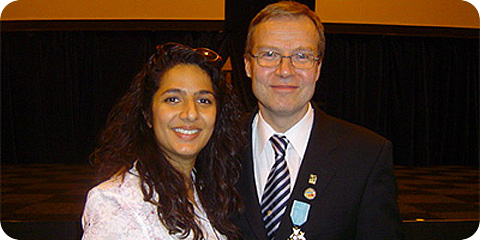
Sabina, Chair of Deaf Parenting UK and Markku Jokinen, WFD President
Sabina have been networking with so many people on local, national and international level and met Markku Jokinen, President of the World Federation of the Deaf during the conference, highlighting the needs of Deaf parents and pressing for Deaf parents to be recognised as a key priority for WFD in the same way as CODA, Women, Youth, Education and Mental health.
Sabina also recognised the uniqueness of Deaf Parenting UK as a national organisation in UK. She checked with other countries and there were none like DPUK apart from small projects here and there, but not a formal organisation of Deaf parents for Deaf parents. It shows on how important for Deaf Parenting UK to present itself as a good model for other countries across the world on enabling confidence, supporting and empowering Deaf parents.
The next congress will take place in Durban, South Africa in 2011. Watch this space.
What is WFD?
The World Federation of the Deaf (WFD) is an international non-governmental organisation comprising national associations of Deaf people. It watches over the interests of more than 74 million Deaf people worldwide -more than 80% of them live in developing countries, where authorities are rarely familiar with their needs or desires.
The WFD was founded in 1951, during the First World Congress of the WFD, held in Rome. Such an early date makes the WFD one of the oldest international disability organisations in the world.
Currently, the WFD has a membership of 127 national associations from the five continents worldwide.
Recognised by the United Nations (UN) as their spokes-organisation, WFD works closely with the UN and its various agencies in promoting the human rights of Deaf people in accordance with the principles and objectives of the UN Charter, the Universal Declaration of Human Rights and other general acts and recommendations of the UN and its specialised agencies. When necessary, WFD uses special, legal or administrative measures to ensure that Deaf people in every country have the right to preserve their own sign languages, organisations, and cultural and other activities.
WFD have national members from 127 countries, of which each representing their country. National members convene in a General Assembly every four years in conjunction with the World Congress.
The General Assembly elects the Board and approves the WFD action plan for the following four years. The Board is the responsible body for implementing those policies approved by the General Assembly.
WFD activities are conducted according to these principles:
- To promote the status of national Sign Languages.
- To improve Deaf education.
- To improve access to information.
- To claim for Deaf human rights in developing countries.
- To promote the establishment of Deaf organisations where none currently exist.
The importance of the WFD is vital since it allows cohesion among all entities of Deaf people in the world. Likewise, this organisation strives for solidarity towards millions of Deaf people from Countries whose political and economic situation deprives them from exercising their rights to sign language; and equal opportunity in all spheres of life, including access to education and information...
For these reasons, all Deaf people must become acquainted with WFD work and support it, because it is through union and commitment that we will get a freer world.
What does it means for Deaf Parents?
The principle of Human Rights and sign language means that at local level, we need to work together to ensure that Deaf parents have access to education, parenting information and enjoy their human rights as Deaf person and as a parent where they are entitled to enjoy family lives and need to have access to information/services without any barriers and discrimination.
LNF Project– Family Fun Day May 2007
Family Fun Day at Crystal Palace Park– 16th June 2007
Rounders match for Deaf Adults & Entertainment for young children. The day turned out to be successful despite the occasional torrential rain, which did not hinder the children’s enjoyment and approximately 30 Deaf parents/adults and 20 children attended.
The children were delighted with the Kid’s entertainment which took place inside a large gazebo, consisting of a ‘Clown’ who proved very popular in story telling, singing and dancing, balloon modelling, face painting, fun and games etc
A Very Big Thank you to all of you that attended the fun day and making it such a great day!
DPUK Recieve Funding
Deaf Parenting UK has received funding from the Local Network Fund (formerly SELCF - South East London Community Foundation) to run 12 'one monthly' Family Day events for Deaf parents and children.
This is an opportunity for children / teenagers to be entertained in a Deaf friendly environment and for Deaf parents to meet/socialise with other Deaf parents.
The first event was planned on 16th June 2007, took place at the Crystal
Palace Park.
DPUK 5th Year Celebration:
Re-Launch Event: 19th May 2006
Deaf Parenting UK celebrated its 5th Anniversary with a re-launch party at Frank Barnes School for Deaf Children in London.
Approximately 60 people - Deaf Parents, friends and families, Deaf organisations and Service Professionals attended the event. The opening speech at the re-launch covered how DPUK can undertake a role to fill the gap in services, how much DPUK has achieved in the last 5 years and also gave a vision of the future. The success of the Deaf parenting Skills Courses was also declared together with the announcement of the New DPUK Logo and Newsletter.
Deaf Health Promotions Information Day–
Disability in Camden (DISC): 7th June 2006: 11am – 3pm
The Co-ordinator attended the event to promote DPUK, which was held at the Resource Centre, Holloway Road. An “Information Stall” was booked with DISC prior to the event in order to display information and resources available from DPUK.
DPUK Training Opportunity: October- November 2006
Deaf Parenting UK is in working partnership with Parentline Plus, a national charity that works for and with parents. Nine successful applicants from across the UK have recently attended 7 training days to become qualified Trainers of Deaf parenting skills.
The Training is OCN accredited, which will be completed by April 2007. On completion of the training, the newly recruited trainers will then deliver Deaf parenting skills courses to Deaf parents within their local area.
Latest News Archives
Select links below:
DPUK Press Release 25 November 2008
DPUK Press Release 7 November 2008
DPUK Press Release 6 November 2008
DPUK Press Release 31st October 2008
DPUK Press Release 21 October 2008
DPUK Press Release 20 October 2008
DPUK Press Release 8th Oct 2008
DPUK Press Release 7th Oct 2008
DPUK Press Release 22nd Sept 2008
DPUK Press Release 19th Aug 2008
Deaf Parenting UK Conference 2008
DPUK Press Release 30 June 2008


